Applying for credit, keeping a teaching job or deciding whether to have children could depend on rules a woman did not choose.
These American cases span different states and generations, and race, income and marital status changed who could use each new freedom.
A lender could treat her paycheck as less reliable

A married woman could bring a paycheck to a mortgage application and still find that the lender discounted her income. The Consumer Financial Protection Bureau records that this was especially common when a woman was of childbearing age. Single women also faced unequal treatment when seeking credit.
Congress passed the Equal Credit Opportunity Act in 1974 to prohibit credit discrimination based on sex or marital status. That was a protection against discriminatory lending, not the first moment every American woman became legally able to own a bank account.
Sources: CFPB: Why the Equal Credit Opportunity Act was passed
A jointly owned home could be mortgaged without telling her

In Louisiana in 1974, Joan Feenstra's husband mortgaged their jointly owned home to secure payment of his legal fees. She was not informed. The state's marital-property rule gave the husband control, although a wife could take a separate formal step to require her consent.
Feenstra learned about the mortgage when foreclosure was threatened. In 1981, the Supreme Court rejected the sex-based rule in Kirchberg v. Feenstra. Louisiana had already changed its law, but the earlier transaction still put her home at risk.
Sources: Kirchberg v. Feenstra, 450 U.S. 455 (1981), opinion of the Court
Marriage could take away her American citizenship

Under a 1907 federal law, an American woman who married a foreign national could lose her U.S. citizenship even if she continued living in the United States. Choosing a husband could therefore change the legal country to which she belonged.
The Cable Act of 1922 removed that consequence for many new marriages, but retained exclusions tied to the husband's eligibility for citizenship. Racial restrictions were part of that history. Later reforms also changed how women who had already lost citizenship could regain it; one wedding date did not produce the same result for everyone.
Sources: National Archives: When Saying I Do Meant Giving Up Your Citizenship
Pregnancy could turn a steady job into a dispute

An employee could be doing her job and still encounter rules that treated pregnancy differently from other temporary conditions. In 1976, the Supreme Court even held that excluding pregnancy from a particular disability-benefit plan did not violate Title VII as it then stood.
Congress responded with the Pregnancy Discrimination Act of 1978. It made pregnancy-based discrimination unlawful under Title VII. The change concerned treatment at work and in benefits; it did not create a universal promise of paid maternity leave.
Sources: EEOC history, 1970–1979
Some teachers kept their weddings secret

Montana teacher Jennie Bell Maynard married in 1913 but continued teaching under her maiden name until she and her husband moved. Another teacher, Adelaide Rowe, concealed her marriage for three years. A wedding could jeopardize a position she was already qualified to hold.
These marriage bars were local policies, not one rule followed by every school. Some rural districts hired married teachers while other districts excluded them. The restrictions could even reach widows with children, making the need for a salary no guarantee of access to one.
Sources: Montana Historical Society: The Debate over Employing Married Women as Teachers
A father could receive automatic preference over a mother

After their son died, Sally and Cecil Reed both sought to administer his estate in Idaho. They belonged to the same legal category of eligible applicants, but state law preferred the man. The appointment did not turn on which parent was better able to do the work.
Sally Reed challenged that rule. In 1971, the Supreme Court ruled that the automatic preference violated equal protection. Women had administered estates before this case; the battle was against a rule that pushed an equally eligible mother behind a father.
Sources: Reed v. Reed, 404 U.S. 71 (1971), opinion of the Court
Marriage could change who controlled her property and work
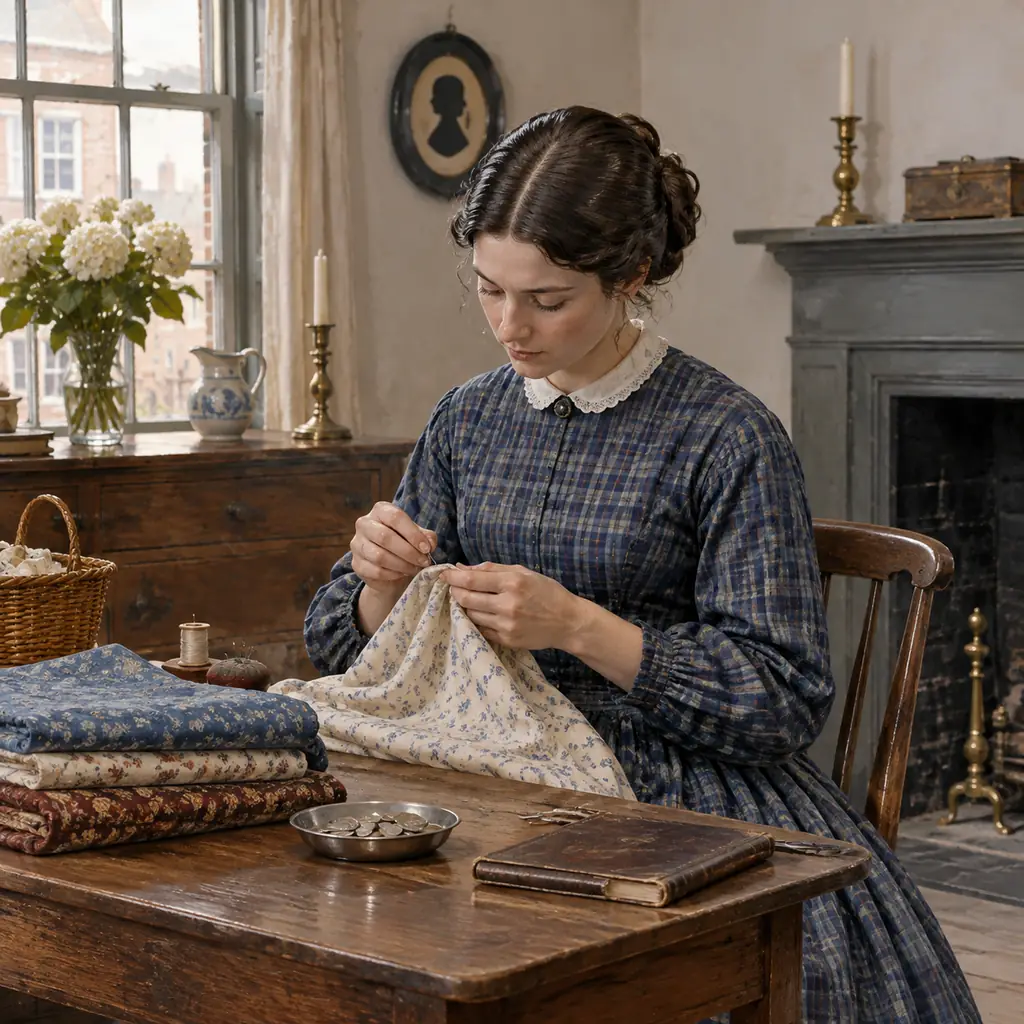
Under the common-law system known as coverture, a married woman's separate legal powers were sharply restricted. A house she brought to marriage and money she earned did not necessarily remain under her independent control.
States changed those rules at different times. New York protected specified separate property in 1848, then expanded married women's ability to work and conduct business on their own account in 1860. These were distinct steps, not one national day of financial independence. They also did not free women who remained enslaved elsewhere. Class, work and legal status also shaped the households described in everyday colonial life.
Sources: New York courts: J.H. v. C.H., historical discussion of married women's property statutes
The newspaper could sort her job choices before she applied

A job seeker opening a newspaper could find separate columns for male and female applicants. The division presented some work as men's territory before a woman had even written an application. The familiar classified page helped maintain the boundary.
The Equal Employment Opportunity Commission initially struggled over how to handle the practice. Its revised guidelines in 1968 made clear that sex-segregated help-wanted headings violated Title VII. Changing the newspaper columns did not instantly change every employer's decisions, but it challenged a very public form of exclusion.
Sources: EEOC history, 1964–1969
Passing the law examination did not guarantee a license

Myra Bradwell passed the Illinois bar examination in 1869, but the state's highest court refused her a license because she was married. Her legal knowledge was not the obstacle. Rules about a married woman's position stood between the examination and the career.
The U.S. Supreme Court did not overturn the refusal in 1873. Bradwell continued publishing the Chicago Legal News and was admitted to the Illinois bar in 1890. Her case was one state's licensing fight, not evidence that no woman anywhere had practiced law before then. The connection between a paycheck and a private home appears in household life during the 1910s.
Sources: Supreme Court exhibition: Myra Bradwell and the Chicago Legal News
The state could refuse to recognize the couple she chose

Mildred and Richard Loving married in Washington, D.C., in 1958, then returned home to Virginia. Virginia's law criminalized their interracial marriage. Their sentence was suspended on the condition that they leave the state and not return together for 25 years.
The couple challenged the restriction. In 1967, the Supreme Court struck down racial marriage bans. This was not a barrier all women faced in the same way: race determined whether the state treated a couple's shared home and marriage as a crime.
Sources: Loving v. Virginia, 388 U.S. 1 (1967), United States Reports
Access to contraception could depend on whether she was married

Connecticut's birth-control law reached into married couples' private lives. In 1965, Griswold v. Connecticut struck down the ban on their use of contraception. That ruling did not settle every restriction faced by unmarried people.
Massachusetts still limited the distribution of contraceptives according to marital status. Eisenstadt v. Baird rejected that unequal treatment in 1972. The two cases concerned different laws and different people, but both involved who could make decisions about starting a family. The marital distinction affected access even when the person seeking contraception was an adult. Other decisions about work, purchases and family space appear in the domestic world of the 1920s.
Sources: Griswold v. Connecticut, 381 U.S. 479 (1965), opinion of the Court · Eisenstadt v. Baird, 405 U.S. 438 (1972), opinion of the Court
Equal work did not always come with an equal wage rate

A woman could stand beside a man doing substantially equal work and receive a lower wage rate because she was a woman. The cost followed her home through the money available for rent, food and savings.
The Equal Pay Act of 1963 addressed sex-based pay differences for covered workers doing equal work requiring equal skill, effort and responsibility under similar conditions. The statute included exceptions such as seniority and merit systems. It was an important legal tool, not an instant end to every pay difference between men and women.
Her pension could cost more for the same monthly benefit

Women working for the Los Angeles Department of Water and Power were required to contribute more to its pension plan than men. The justification was that women, as a group, tended to live longer. An individual employee paid more now to receive the same monthly retirement benefit later.
In the 1978 Manhart case, the Supreme Court rejected that sex-based contribution policy under Title VII. An average calculated for a group did not justify treating every female employee as though her own future lifespan were already known.
Sources: Los Angeles Department of Water and Power v. Manhart, 435 U.S. 702 (1978) · EEOC history, 1970–1979
A jury pool could leave women out unless they volunteered

Louisiana once required a woman to file a written declaration before she could be selected for jury service. Men did not have to take that extra step. In the district examined in Taylor v. Louisiana, women made up 53 percent of eligible citizens but were scarcely represented in the jury pool.
The Supreme Court rejected the system in 1975 because it denied a criminal defendant a jury drawn from a fair cross-section of the community. Women already served in other places; the case challenged their systematic exclusion here. Employment and care for children met wartime demands in these American household stories.
Sources: Taylor v. Louisiana, 419 U.S. 522 (1975), opinion of the Court
A girl's school opportunities were not simply a matter of ability

A student could want a course, a team or a scholarship and find that the opportunity depended on sex. Educational institutions could channel girls and boys toward different futures long before either student entered a workplace.
Title IX, enacted in 1972, prohibited sex discrimination in covered education programs receiving federal financial assistance. Its reach extended beyond sports to areas including educational access and financial aid. Implementation took rules, complaints and enforcement. The law did not mean every institution had previously excluded women, or that all differences disappeared at once.
Sources: Department of Justice: Title IX, forty years of educational equality
A marathon finish could come before official acceptance

Bobbi Gibb completed the Boston Marathon in 1966 without being an official entrant. In 1967, Kathrine Switzer received a race number after entering as K. V. Switzer. Their participation came before the race established its official women's division.
That division opened in 1972 with eight women in the field. The distinction matters: women had already covered the distance before the organizers formally accepted a women's race. This was an organizer's barrier in a particular event, not a nationwide law making women's running illegal. Public expectations and private concerns also meet in family life in the 1950s.
Sources: Boston Athletic Association: Boston Marathon history
Voting rights arrived unevenly, even after the amendment

Some women could vote in their states before 1920. The Nineteenth Amendment then barred denial of the vote on account of sex across the country. Its ratification followed decades of organizing, petitions, marches and imprisonment.
The amendment did not remove racial intimidation, discriminatory registration practices or every citizenship barrier. Many Black women, especially in the South, continued fighting for access to the ballot. The Voting Rights Act of 1965 was another major milestone. A national constitutional change and a woman's ability to cast a ballot were not always the same event.
Sources: National Archives: The 19th Amendment · National Park Service: Did Women Earn the Right to Vote on August 18, 1920?
An employer could make decisions about her possible future children

Battery manufacturer Johnson Controls excluded women capable of bearing children from certain jobs involving lead exposure unless they could document infertility. A woman did not have to be pregnant to lose the choice of that work. Men facing reproductive risks were not excluded in the same way.
In 1991, the Supreme Court held that the policy violated Title VII as amended by the Pregnancy Discrimination Act. Workplace hazards still mattered. The ruling rejected the employer's sex-based decision about who could take those jobs because of possible future parenthood. Property and the work of building a home take another form in these accounts of frontier families.
Sources: United Automobile Workers v. Johnson Controls, 499 U.S. 187 (1991), opinion of the Court